

You catch your reflection in a store window , not the bathroom mirror you’ve rehearsed for, but an unexpected one , and for half a second, the person looking back at you is a stranger. Not unrecognizable. Just... not who you thought you’d become.
That gap , between the self you perceive and the self you experience , is where this story begins.
The Airtight Room
For most of my adult life I was the kind of person who needed evidence before I’d believe anything. I worked in IT. I trusted systems, logic, things that could be tested and reproduced. If you’d told me I’d one day be writing about consciousness and philosophy and the strange intelligence of the body, I would have smiled politely and changed the subject. Spirituality was for people who hadn’t read enough science. Philosophy was for people with too much time. I was neither.
I was also, without fully realising it, an introvert living inside a belief system so airtight that nothing unfamiliar could get in. Mainstream science was my bible , not because I’d examined every alternative and chosen it, but because it was the only lens I’d ever been handed. And a single lens, no matter how sharp, only ever shows you one angle of the room.
Then, about ten years ago, the room collapsed.
The Body Knew First
I won’t dress it up. It was a personal crisis. Not the first , I’d had rough patches before, the kind you muscle through and file away under lessons learned. But this one was different. Not because it was worse. Because something in me was ready to actually feel it rather than solve it.
I remember the exact moment. Not what day it was, not what triggered it , but the shift in my body. It was physical before it was anything else. My appetite vanished. Not in the way it disappears when you’re stressed and forcing down toast , it simply left, the way a guest quietly slips out of a party. My emotional state didn’t dull; it intensified. Music I’d heard a thousand times suddenly sounded like it was being played for the first time. A sentence in a book would stop me mid-page, not because I didn’t understand it but because I understood it somewhere deeper than thinking.
And then the walking started.
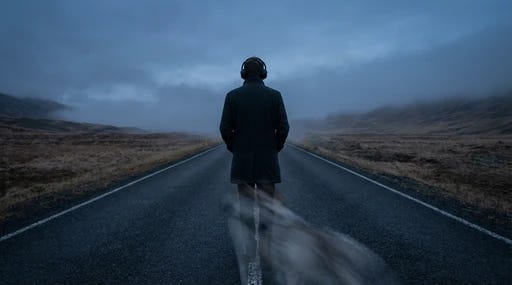
I can’t explain where the energy came from. I wasn’t training. I wasn’t following a plan. I’d put my headphones on, step out the door, and just... go. For hours. Day after day, for months. Time dissolved. I wasn’t checking my phone, I wasn’t counting steps. My legs would be screaming , I know this now because they must have been , but the signals never reached me. My body was moving and my mind was somewhere else entirely, absorbing everything it encountered like a sponge thrown into the ocean.
The side effect , and I almost hesitate to mention it because it sounds like a sales pitch , was that I lost over thirty kilograms in about seven or eight months. No diet. No rules. No goal. Weight loss wasn’t the target; there was no target. There was only this strange, beautiful compulsion to keep moving, keep listening, keep taking in.
Looking back, I think my body knew something my mind hadn’t caught up with yet. This state is on my orbit and hitting me once every 7-8 years, it is like an orbital recalibration process, unplanned, unpredictable. The crisis hadn’t broken me. It had cracked the lens.
The Version That Slipped Away
But here’s the part that haunted me.
During those seven or eight months, I met someone. Not another person , a version of myself. A version that felt fully alive. Present. Engaged with reality in a way that made my ordinary life look like it had been lived behind frosted glass. Everything was sharper, richer, more immediate. I wasn’t performing wellness , I was well, in a way I’d never experienced before.
And then it dissolved. The energy settled. The walking stopped. And that version of me , the one that felt so real, so undeniably there , slipped away. Like waking from a dream you can still feel but can’t re-enter.
I tried. I tried to think my way back to it. To reconstruct it through discipline, through willpower, through understanding. But the harder I reached for it through my cognitive system, the further it receded. It was like trying to fall asleep by concentrating on falling asleep , the very effort defeats the purpose.
What stayed with me, though, was the knowledge that this version exists. I didn’t imagine it. I lived it. It’s in me , but I don’t have direct access to it. I can’t summon it on command. And that realisation became the single most important question of my life:
How do we create the conditions in which our better self emerges?
Not force it. Not engineer it. Create the conditions. Because that better self didn’t arrive through a decision I made. It emerged through a crisis I didn’t choose, in a body I wasn’t consciously directing, through relationships and encounters I couldn’t have planned. It was relational , drawn out by the specific configuration of circumstances, people, and experiences I happened to be immersed in.
Our better self, it turns out, isn’t something we build. It’s something that emerges when the conditions are right. And those conditions are almost never internal , they’re relational.
What Poured In Through the Crack
What poured in through that crack changed everything.
I discovered Professor Yeshayahu Leibowitz, who showed me something I’d never considered possible , that contradicting values can make peace inside the same person. That you don’t have to resolve every tension to live with integrity. That was revolutionary for someone who’d spent his whole life sorting the world into correct and incorrect.
I found Nietzsche , not the caricature, but the real man , whose intellectual courage was so ferocious it eventually cost him his sanity. There’s something sobering about that. The willingness to follow a thought wherever it leads, even when wherever it leads is a place no one can follow you.
Alan Watts was the first person who could explain Eastern philosophy in a language my Western-trained mind could actually receive. Through him I encountered the Tao , not as religion, not as mysticism, but as a description of something I was already beginning to feel: that reality isn’t a thing you stand outside and analyse. It’s a current you’re already in.
Terence McKenna taught me about our relationship with nature , the deep, ancient, unsettling conversation between human consciousness and the plant world that modern civilisation pretends isn’t happening.
Robert Sapolsky gave scientific grounding to something I’d been sensing for a long time: that the free will we build our entire moral and legal systems on may not exist at all.
James Fadiman illuminated the true value of psychedelics , not as escape, but as a kind of recalibration.
And more recently, Roger Penrose opened a door into the physics of consciousness itself, suggesting that the answers might live at the quantum level, in places too small and too strange for ordinary intuition.
None of them agreed with each other on everything. That was the point.
The Simplest Thing in the World
Here’s what ten years of exploration taught me , and it’s the simplest thing in the world, but it rewired how I process everything:
True-self has no fixed address
Truth is relative. It serves the viewpoint of the observer. There isn’t one correct version of it floating somewhere above us, waiting to be discovered. But , and this is the part that changed me , when truths converge, when different observers looking from completely different angles start describing the same underlying shape, something extraordinary happens. A broader lens emerges. One that no single perspective could have produced alone.
I used to resist anything that didn’t align with my truth. Instinctively. Automatically. Like an immune system rejecting a foreign body. And honestly, that reflex hasn’t disappeared , it’s biological, it’s how we’re wired. But now, when I feel that resistance rise, instead of letting it slam the door, I get curious. I notice it. And then I get this urge , almost physical , to find the relations between truths rather than the evidence to disprove one or the other.
That shift , from defending what I know to exploring what connects what we each know , is the most valuable thing that’s ever happened to me.
So this is what this space is for
I’m not a philosopher. I’m not a scientist. I’m not a guru. I’m just an ordinary guy , a mid-age migrant, a father, someone who fixes systems for a living , who at some point started listening to his own experience as a source of truth rather than accepting the reflected version of it in the image of our reality.
What I’ll share here are alternative interpretations. Not the truth , an angle on it. A perspective shaped by crisis, by walking, by ten years of collecting insights from thinkers who rarely get placed in the same room. Consciousness. Relationships. The self. Why we suffer. Why the body knows things the mind refuses to accept. And that question , the one that started it all , how do we create the conditions for our better self to emerge, knowing we can’t simply think our way there?
My hope isn’t to convince anyone of anything. Convincing is a cognitive exercise, and the mind has defences that make fortresses look flimsy. My hope is simpler and stranger than that: that by telling these stories honestly , the way they actually happened, the way they actually felt , something in them might resonate. Not up here, in the logic centre. But deeper. In the place where you already know what’s true before you can explain why.
That resonance , that felt sense of yes, I’ve experienced something like that , is the only authority I trust anymore.
Let’s see where it leads.