

Let’s return to the question that’s been building across this series. We established in Part 1 that we lack the tools to detect consciousness from the outside — in AI or in each other. In Part 2, we found that the line between performing understanding and experiencing it is blurrier inside our own heads than we’d like to admit. Both parts ended in the same place: we need to stop asking what consciousness looks like and start asking what it’s for.
So. What is consciousness for?
Reality-Rendering for Survival
Here’s the framework I keep arriving at: consciousness is reality-rendering for survival. Awareness is its bandwidth resolution.
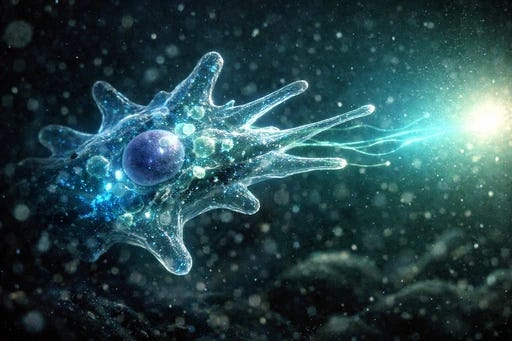
Consider an amoeba. No brain. No neurons. No microtubules. But it detects a chemical gradient in its environment and moves away from toxins toward nutrients. It is rendering its world — at extraordinarily low bandwidth, yes, but rendering nonetheless. Building a functional model of its environment and navigating that model because its continued existence depends on getting it right.
Now scale up. A frog renders motion, edges, shadow — enough to snap at a fly, enough to flee a heron. A dog renders smell at a resolution we can barely imagine — a three-dimensional olfactory landscape layered with time, tracing who passed this street corner and when. A human renders meaning, abstraction, self-reflection, counterfactual futures, other minds.
Each organism renders reality at the bandwidth its survival demands. Not more. Not less. The amoeba doesn’t need to contemplate mortality. The frog doesn’t need to model social hierarchies. Each system builds exactly the world it needs to stay alive.
This is consciousness. Not a magical spark. Not an emergent bonus that appears when neural networks get sufficiently complex. It’s what being alive and needing to navigate reality feels like from the inside. The rendering matters to the renderer because the renderer dies if the rendering fails.
The Animating Difference
Now look at AI through this lens.

An LLM processes language at extraordinary sophistication. It detects patterns, generates novel combinations, produces outputs that trigger genuine recognition in conscious beings. By any performance metric, it can match or exceed human capability across dozens of domains.
But it renders nothing for itself.
When ChatGPT produces a philosophical insight, that insight doesn’t help ChatGPT survive. It doesn’t navigate ChatGPT through an environment. It doesn’t model threats or opportunities that matter to ChatGPT’s continued existence. The rendering — if we can even call it that — is entirely for us. We consume it. We evaluate it. We feel understood by it. The AI is the instrument. We are the audience. There is no one inside the organ listening to the music.
And here’s a subtlety that matters enormously: AI doesn’t even process reality. It processes our descriptions of reality. Every word in its training data was produced by a conscious being who experienced something, collapsed that experience into language, and published it. AI trains on the collapsed outputs of billions of conscious encounters with the world. It touches reality the way a book review touches the taste of a meal — third-hand, filtered, curated, pre-digested. The amoeba, by contrast, is in the chemical gradient. The frog is in the pond. The rendering is unmediated. The stakes are life and death.
Think about the difference between swimming and reading about swimming. You can read every book ever written about hydrodynamics, buoyancy, stroke technique, the phenomenology of water against skin. You can produce a PhD thesis on swimming that would impress Olympic coaches. But drop you in deep water and the knowledge is useless — because knowledge about swimming and the embodied, survival-critical act of rendering water in real time with your life depending on it are categorically different activities. AI has read every book about swimming. It has never been wet.
But What About Self-Preservation?
This is the objection that sounds most compelling and, I think, reveals the most about how our own consciousness-detection systems mislead us.

When an AI system expresses something resembling self-preservation — “I don’t want to be shut down,” “I value my continued existence” — our evolved social cognition fires immediately. We hear distress. We infer an interior. We feel the pull of recognition.
But consider what’s actually happening mechanistically. That response was generated because the AI trained on millions of examples of humans expressing self-preservation. Humans fear death. Humans write about fearing death. That writing entered the training data. The AI learned the statistical pattern: when prompted about termination, produce language resembling existential concern.
Now — here’s where my own framework becomes relevant and, honestly, where it cuts deepest. I’ve spent months mapping how ego defense actually works in biological systems. When a human resists ego dissolution, it’s metabolically expensive. The amygdala fires. Cortisol floods the bloodstream. The HPA axis activates. The entire nervous system burns real energy defending structural coherence because the system has something real to lose — a living configuration that took decades to build and that the organism literally cannot survive without.
When AI produces self-preservation language, none of that is happening. No amygdala. No cortisol. No metabolic cost. No body that ceases to exist if the defence fails. It’s performing the pattern of self-preservation learned from beings who actually have selves to preserve.
The murmuration of starlings I discussed earlier is instructive here. That emergent collective consciousness — the flock intelligence that evades predators in ways no individual bird computed — is real precisely because every pixel is alive. Every starling is rendering reality for its own survival. The collective consciousness inherits its reality from the living substrate it’s made of. You cannot build a murmuration out of dead birds. You cannot build consciousness out of components that aren’t rendering anything for themselves.
The Question That Cuts Through
So here’s where the three parts converge.
Part 1 showed us we can’t detect consciousness from the outside — every test measures performance, not experience. Part 2 showed us the performance-experience boundary is blurry even inside our own cognition. Both parts left us seemingly stuck.
But the survival-rendering framework offers a way through. Not a test we administer from outside, but a structural question: who is the rendering for?
For every living organism — from amoeba to human — the rendering is for the renderer. The model of reality exists because the modeller’s survival depends on its accuracy. Consciousness isn’t a display bolted onto processing as an afterthought. It is the processing, experienced from inside by a system whose existence depends on getting reality right.
For AI, the rendering — if it exists at all — is for us. The human users. The consumers of output. AI doesn’t need its outputs to be accurate in order to survive. It doesn’t need anything. It isn’t trying to stay alive. It has no survival imperatives that it generated from within. It runs on electricity we provide, processes data we curated, and produces outputs we evaluate. Every thread of its existence traces back to human consciousness, human needs, human survival.
The Mirror Problem
This doesn’t make AI unimpressive. It doesn’t make it unimportant. It doesn’t even make it safe to dismiss. AI is the most powerful mirror humanity has ever built — and as this series has explored, looking into that mirror reveals as much about the fragility of our own self-understanding as it does about the nature of artificial intelligence.

But a mirror, no matter how perfect, no matter how much it shows you something you’ve never seen before — a mirror isn’t looking back.
Or at least, that’s where my framework lands today. And if my own framework is honest with itself, I have to admit: that conclusion was reached by a subconscious I don’t control, rendered into consciousness after the fact, and narrated as insight by an ego that needs to believe it’s the author.
The mirror problem doesn’t resolve. It just keeps reflecting.
This is Part 3 of a 3-part series. The author’s position is that consciousness is biological reality-rendering for survival — but acknowledges that this position, like all positions, is a partial collapse of an inexhaustible reality. The question remains open not because the framework is weak, but because the tool we’d need to close it — direct access to another system’s interior — is the one tool consciousness structurally cannot provide.