

The Science of Possibility
There’s a popular way of telling the story of quantum physics that goes something like this: particles behave differently when observed, therefore consciousness shapes reality. It’s a beautiful idea.
But the actual physics points to something even more extraordinary.
Before observation, particles don’t exist as definite things. They exist as clouds of possibility — what physicists call superposition. Nothing is fixed. Nothing is actual.
It’s only when an observer enters the picture that possibility collapses into something real, something singular, something you can point to and say that happened.
Consciousness is the condition without which reality doesn’t show up at all.
Now take that principle and notice something about your own experience. Right now, everything you see, hear, and touch feels singular and definite. Not fuzzy. Not probabilistic.
You’re experiencing a collapsed reality. Which means — by the logic of the physics — an observer must be present. Whatever, whomever that observer is.
But here’s where it gets really interesting. This isn’t just happening at the particle level. It’s happening between people.
When your mother looks at you, she collapses one version of you into existence — the child, the caretaker, the source of worry. When your colleague looks at you, a completely different version emerges.
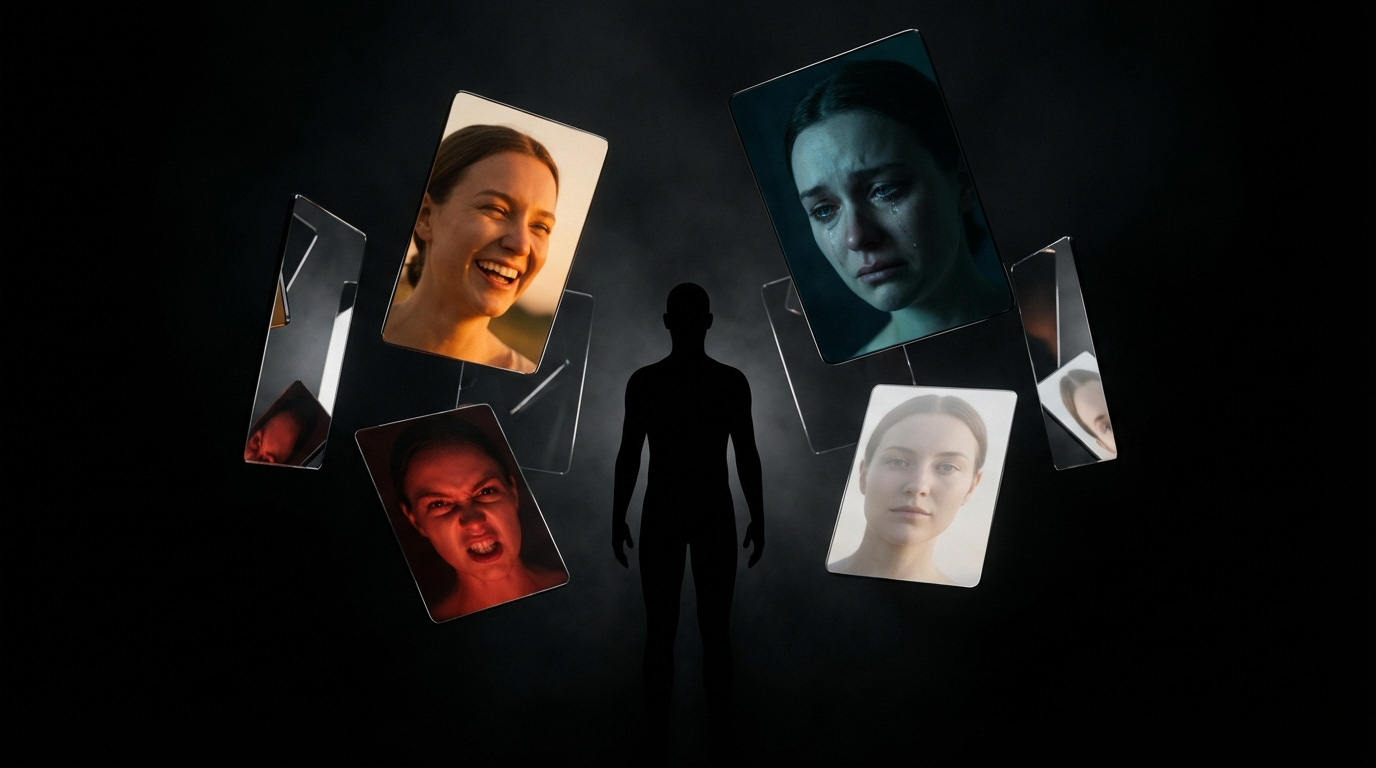
When your lover sees you, another still. These aren’t masks. They’re different collapses of your superposition of possible selves, depending on who’s doing the observing.
Your identity doesn’t live inside you. It emerges in the space between you and whoever is witnessing you.
This is something human beings have intuited for a very long time.
The Relational Fabric of Identity
In Southern African philosophy there is a concept called Ubuntu — often translated as ‘I am because we are.’ It describes a world where individual identity is inseparable from the relational fabric that holds it.
In Hasidic thought, the Kotzker Rebbe offered a complementary warning: ‘If I am I because you are you, and you are you because I am I — then I am not I, and you are not you.’
In other words, the relationship has to be between two real, coherent beings for it to generate real identity.
These traditions weren’t doing quantum physics. But they were pointing at the same structural truth: reality — including who you are — is not a fixed thing sitting inside you. It’s a living relationship. And the quality of that relationship determines what version of reality gets to exist.
And this pattern — observer meeting observed, possibility becoming actual — doesn’t stop at people. It repeats at every scale. Between particles. Between individuals. Between communities. Between entire systems.
The same relational architecture, cascading fractally from the smallest measurable interaction to the largest structures we can conceive of.
The double-slit experiment isn’t showing us a quirky lab result. It’s showing us the fundamental architecture of existence.
Which leaves one thing hanging in the air. If every observed thing needs an observer, and every observer is themselves observed by another observer... somewhere at the root of that infinite cascade, there must be an observer that is itself unobserved. The one that anchors the whole thing.

The fact we experience a singular, definite reality at all is already evidence of its presence.
We can’t know what that is. But the physics tells us it must be there.
And maybe that’s the most honest place any of us can stand — not claiming to know the ultimate nature of that observer, but recognising that the fact we experience a singular, definite reality at all is already evidence of its presence.
Reality is not a thing you look at. It’s a relationship you’re inside of. And it goes all the way down — and all the way up.
References
John Archibald Wheeler (1990) — Information, physics, quantum: The search for links (in Complexity, Entropy, and the Physics of Information)
William James (1890) — The Principles of Psychology
Desmond Tutu (1999) — No Future Without Forgiveness
Thomas Nagel (1986) — The View from Nowhere
Fritjof Capra (1996) — The Web of Life: A New Scientific Understanding of Living Systems