

In Part 1, we established three things. First, that neuroscience has shown decisively that decisions are made before conscious awareness registers them , consciousness displays decisions, it doesn’t make them. Second, that the experience of free will exists for a reason: evolution built it because individual identity and social cohesion both require felt agency to function. Third, that free will operates less like an open field and more like a compass , always pointing somewhere, navigating between two signal systems.

Alt text: A person holding a glowing compass at a misty crossroads.
Now we need to ask: what are those two signal systems? And what happens when they pull in opposite directions?
The Body’s Somatic Truth
Antonio Damasio’s research program, spanning three decades at USC and the University of Iowa, has fundamentally reshaped how neuroscience understands decision-making. His somatic marker hypothesis , supported by extensive clinical work with patients who suffered damage to the ventromedial prefrontal cortex , demonstrates that emotions are not noise interfering with rational thought.
They are bodily states that guide decisions before conscious deliberation begins. Damasio’s patients could reason perfectly well in the abstract. They could analyse options, weigh probabilities, articulate pros and cons. But in real life, they made catastrophic decisions , entering toxic relationships, losing money on obviously bad investments, repeatedly walking into situations any healthy person’s gut would scream to avoid.
What they’d lost wasn’t intelligence. They’d lost access to the body’s compass , the pre-conscious emotional signals that tell you something is wrong before you can say what. This is one signal system. Call it the body’s truth. It’s ancient, pre-linguistic, rooted in evolutionary survival logic encoded long before culture, language, or conscious thought existed.
The body doesn’t hallucinate threats for entertainment , it detects patterns that consciousness hasn’t caught up with yet.
It speaks in sensation: the gut feeling, the inexplicable attraction or repulsion, the tightness in your chest when you walk into a room and something is off. It interfaces directly with reality through the senses , your biological antenna system picking up information from the environment and encoding it as felt experience. Critically, this signal system is never wrong on its own terms. It’s reading real information.
The Social Logic of the Tribe
Roy Baumeister’s research at Florida State University revealed something remarkable: social exclusion activates the same neural pathways as physical pain. The anterior cingulate cortex and insula , brain regions that light up when you stub your toe or burn your hand , fire identically when you’re left out of a group, rejected by peers, or made to feel you don’t belong.

This isn’t a design flaw. It’s a design feature. For most of human evolutionary history, exile from the group was a death sentence. A solitary human on the African savanna was a dead human. So the brain evolved to treat social exclusion with the same urgency as a physical wound , because functionally, it was one.
The brain evolved to treat social exclusion with the same urgency as a physical wound , because functionally, it was one.
This is the second signal system. Call it the tribe’s truth. It speaks in meaning rather than raw sensation: duty, honour, guilt, shame, belonging, purpose. It calibrates your behaviour against collective values , the shared behavioural benchmarks that allow groups to function as coherent organisms.
When you feel pride, it’s this system telling you you’re aligned with what your social world values. When you feel shame, it’s the same system signalling misalignment. And just like the body’s truth, the tribe’s truth is reading real information. Social reality is real. The values encoded in your social environment have genuine consequences for your survival and flourishing.
The Navigational Space of the Will
Here’s where free will lives , and here’s where suffering originates.
Your conscious experience sits at the junction between these two signal systems. Both are feeding information upward into awareness. Both are legitimate. Both are reading real features of your situation. And both arrived at their conclusions before your conscious mind knew they were processing.
When these two systems align , when what the body knows and what the tribe needs point in the same direction , the felt experience is conviction. Flow. Coherence. That sense of ‘I know exactly what to do and it feels right.’ This is what we experience as self-love, though it isn’t really an emotion. It’s a coherence signal , the felt registration that your internal observations and your relational configuration are in alignment.
When they conflict , when the body is screaming one thing and the social structure demands another , the felt experience is suffering. Not pathological suffering. Not disordered suffering. Navigational suffering. The system is telling you that you’re caught between two legitimate but incompatible signals, and something needs to change.
Consider someone who is socially admired , successful by every collective metric , but who cannot feel lovable. Conventional psychology often treats this as a disorder: low self-esteem, imposter syndrome, cognitive distortion requiring correction. But what if the body’s signal is accurate?
What if it’s reading something the social metrics can’t capture , that this person is in a relational configuration where they are valued for what they produce but not witnessed for what they are? The suffering isn’t a malfunction. It’s information. The compass is working. Free will, then, is the conscious experience of navigating this space.
Complementarity and the Bohr Resolution
Niels Bohr won the Nobel Prize for establishing the principle of complementarity in quantum physics. Light behaves as a wave when you measure it one way, and as a particle when you measure it another. These aren’t contradictions , they’re complementary descriptions of the same reality, each valid within its frame of measurement.
The contradiction exists only if you insist that one description must be the complete description. Light is richer than any single measurement can capture. Free will works the same way. At the mechanistic level , the level of neurons, readiness potentials, subconscious processing , determinism is correct.
Your decisions are downstream of pre-conscious emotional patterns, evolutionary programming, and encoded relational history you didn’t choose. No ghost in the machine is making uncaused choices. At the experiential level , the level where you live, love, keep promises, feel the weight of betrayal , free will is correct.
The felt sense of agency is real, functionally necessary, and structurally load-bearing. It holds up self-identity. It holds up social contracts. It holds up the entire architecture of human meaning. These aren’t contradictions. They’re complementary collapses of the same reality at different scales of observation.
The Reality of the Rendering
So is free will an illusion? Consider the colour red. When you look at a rose, your eyes detect electromagnetic radiation at a wavelength of roughly 700 nanometres. Your visual cortex processes this signal and renders it into the experience of redness , that vivid, unmistakable quale.
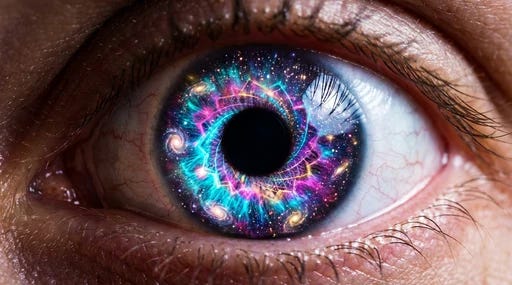
Free will is the rendering of pre-conscious navigational processes into a format conscious experience can work with.
Now: is redness ‘real’? The electromagnetic wavelength is real. Your experience of redness is real. But they’re not the same thing. Redness is a rendering , your nervous system translating raw physical data into a format consciousness can use. Nobody calls colour an illusion. It’s a rendering of something real, and it’s functional.
Free will is the same kind of thing. It’s the rendering of pre-conscious navigational processes into a format conscious experience can work with. The raw mechanism is deterministic. The rendering , the felt experience of choosing, weighing, deciding , is real at the level where it operates. And it’s functional: without it, no self-identity, no social cohesion, no meaning.
The Compass in Motion
You’re not free in the way you think you are , an uncaused cause, a ghost making choices in a vacuum. You’re free in a way that’s far more interesting: you’re the site where two ancient signal systems , body and tribe, individual truth and social truth , converge into felt experience. The compass needle moves, and it feels like choosing. And that feeling is as real as the colour of a rose.
Renderings are real. They’re how reality becomes livable. And the deepest irony? Your reaction to this very piece , the agreement or resistance arising in your body right now, before your conscious mind has finished articulating why , is itself a demonstration. You didn’t choose that reaction.
But the fact that it’s yours, that it matters, that it says something about who you are , that’s the compass working. That’s the rendering doing exactly what evolution designed it to do. You’re not the player. You’re not just the screen. You’re the moment where signal becomes experience , where the universe’s competing truths become someone’s felt life.
And that is worth far more than freedom.
References:
Baumeister, R. F., & Leary, M. R. (1995). The need to belong: Desire for interpersonal attachments as a fundamental human motivation. *Psychological Bulletin*, 117(3), 497-529.
Bohr, N. (1928). The quantum postulate and the recent development of atomic theory. *Nature*, 121, 580-590. (Como Lecture)
Chalmers, D. J. (1996). *The Conscious Mind: In Search of a Fundamental Theory*. Oxford University Press.
Damasio, A. R. (1994). *Descartes' Error: Emotion, Reason, and the Human Brain*. G. P. Putnam's Sons.
Dennett, D. C. (2003). *Freedom Evolves*. Viking Press.
Eisenberger, N. I., Lieberman, M. D., & Williams, K. D. (2003). Does rejection hurt? An fMRI study of social exclusion. *Science*, 302(5643), 290-292.