

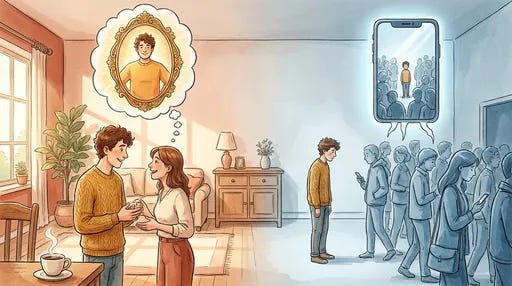
Almost everyone who’s spent real time on a dating app has had the same quiet thought, usually late, phone going dark on their chest: maybe there’s something wrong with me. It arrives after enough silence, or enough matches that went nowhere. It doesn’t feel like a passing bad mood. It feels like something you’ve quietly worked out about yourself. This series looks at that thought carefully: what the app is really measuring when it seems to be measuring you, and why the result is better understood as an estimate of your odds of a match in one particular place than as a verdict on your worth.
What the app actually grades
Start with what you actually put on the app. A few photos: your best ones, the angle you’ve learned is kindest, the day you looked happiest. A bio you rewrote more times than you’ll admit, tuned to sound easy and interesting and not trying too hard. It isn’t a lie. It’s a projection, your own idea of the most appealing version of you, flattened onto a screen. One dimension. Your best guess at your best self. Researchers who’ve compared dating profiles to the people behind them find exactly this: the photos skew systematically flattering, tuned for effect (Hancock & Toma, 2009). We put our best face forward, often literally.
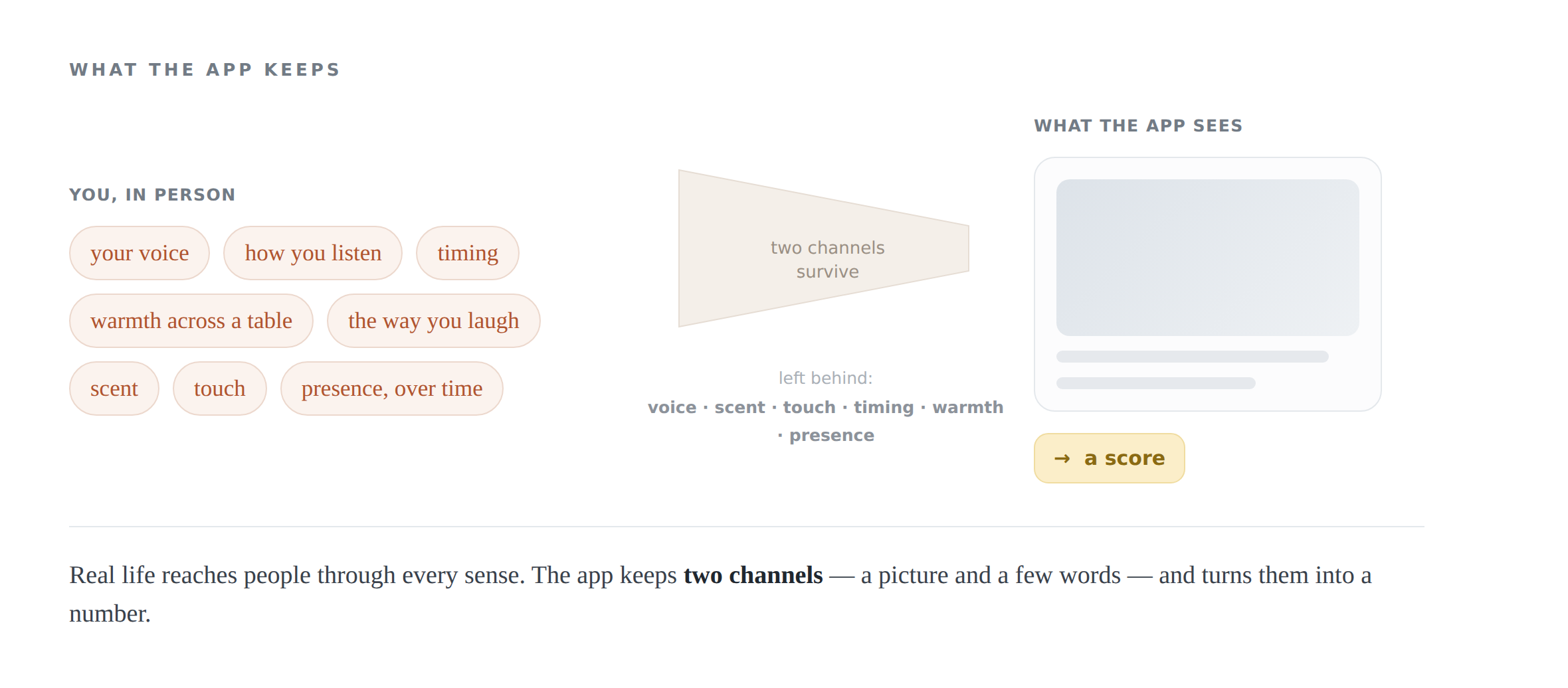
And that flattened projection is the entire thing the market is grading. Your voice never makes it onto the screen. Nor does the way you actually listen, the particular warmth you give off across a table, your timing, the way you smell, or what happens to a room when you laugh. All of it, the whole set of senses people use to fall for each other, is gone. The app keeps two channels: some pictures and some words. Everyone judging you is judging those two channels, against thousands of others, in about a second.
The flood and the silence
You can see the split most clearly at the extremes, and the surveys track it. A woman signs up and the attention arrives in a flood: instant, enormous, and almost none of it about her. It would land on anyone standing where she’s standing. A man signs up, does everything right, and meets a silence so complete he starts checking whether the app is switched on. This isn’t just anecdote. Pew’s 2023 study of U.S. online daters found men far more likely to report they hadn’t received enough messages, and women, especially younger women, far more likely to feel overwhelmed by them, and to be sent unwanted, explicit content. Yet both the flooded and the ignored tend to arrive, within a couple of weeks, at the same private verdict about themselves. She feels hollow in the middle of all that wanting. He feels like there’s less of him than he thought. Different weather, same conclusion: it must be me.
And that conclusion feels airtight, because of how self-worth actually works. Your sense of your own value isn’t a fixed thing you carry around. It behaves more like a gauge, rising and falling with how accepted you feel by the people near you. Psychologists even have a name for it: the “sociometer,” an internal meter for belonging (Leary & Baumeister). It’s a good system. In a real community it keeps you tuned to your people. But hand that meter to an app and it does what it always does. It reads the room. Only now the “room” is a market of thousands, grading a two-channel fragment, and the meter faithfully turns the result into a feeling about you. The number lands like a verdict on your worth because the meter can’t tell the difference between this projection didn’t rank here and you are not enough. It only reports the reading.
A different mirror, a different self
Your experience on the app isn’t set by how lovable you are. It’s set by two things: which crowd is reflecting you back, and at what scale. Real life reflects you through a particular room: people who share some of your world, met one at a time, over time, with every sense switched on. The app reflects you through the entire market at once, on two channels, in a second. Same person. A different mirror at a different scale, so a different self comes back.
Neither reflection is lying. The app’s score is honest about the projection it was handed, ranked against the pool it was dropped into. It’s just honest about that: a fragment, in that crowd, at that scale. What it produces is closer to a probability (how likely is this profile to get a match, here, right now) than a measure of who you are. And a probability in one market was never going to be the truth about the person a first date actually meets. That person doesn’t exist on the app. They were never invited.
How much of you is the room
So the quiet thought has its arrow pointing the wrong way. The app didn’t uncover something true about you that real life is too polite to mention. It took a still photograph of your best angle, ranked it against a market of other still photographs, and handed the odds to a meter that can’t tell a projection from a person. The score is real. It’s just real about a version of you that only exists in one place, and about your chances there, not your worth.
There is a larger version of this worth sitting with, because it reaches well past dating. We go through the day feeling like the fixed author of our own moods and thoughts and choices. But change the room and the mood moves, the thinking bends, the next decision leans a little differently, and through all of it the feeling of being the one in charge stays perfectly still. The app is just an unusually clear case of it: a setup that reaches in, quietly adjusts how you feel about yourself, and hands the result back as though it were a fact you turned up on your own. It’s worth asking how much of what you take to be simply you is the room you happen to be standing in.
Which raises the harder questions, and they’re where this series goes next: why the market sorts people so brutally, why the same machine feels like a flood to one person and silence to another, and what actually changes when you step off the two-channel screen and back into a room. But it starts with the smallest correction, the one that takes the weight off: the app didn’t score you. It scored the version of you that you can fit through a screen, and guessed at your odds.
Sources & further reading:
Pew Research Center, “The Experiences of U.S. Online Daters” (2023).
Jeffrey T. Hancock & Catalina L. Toma, “Putting Your Best Face Forward: The Accuracy of Online Dating Photographs,” Journal of Communication (2009).
Mark Leary & Roy Baumeister, sociometer theory: the idea that self-esteem functions as an internal gauge of social acceptance and relational value.