

Let me start with something strange.
Tonight, when you fall asleep, there’s a decent chance you’ll fly. Not metaphorically. You’ll lift off the ground, feel the wind, see the world shrinking beneath you , and it will feel real. Not like imagining flight. Like experiencing it.
The Astronaut in Your Bed
Here’s what’s wild about that: when you’re in deep sleep, your sensory system shuts down. Pinch a sleeping person , nothing. Call their name , silence. Your body is still obeying gravity, still pressed into the mattress, but the part of you that feels weight? It’s gone quiet.
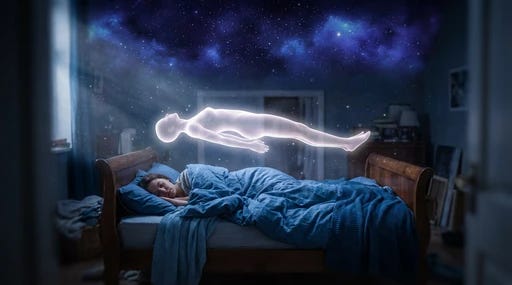
And when the gravity signal drops out, your brain doesn’t just show a blank screen. It shows you what weightlessness feels like. You’ve been an astronaut your whole life. You just only remember it in fragments.
You’ve been an astronaut your whole life. You just only remember it in fragments.
I bring this up because it tells us something important about the question we’re actually here to explore: What are you afraid to know about yourself?
Most of us assume the scary truths are buried deep , some dark chamber of the psyche where our worst qualities are hiding, waiting to be excavated. The whole language of self-discovery is built around digging: uncover your trauma, unearth your shadow, excavate your authentic self.
But what if the thing you’re afraid to know isn’t buried at all? What if it’s playing on the surface , and you’ve just been taught to look the other way?
The TV That Thinks It’s the Director
Here’s a thought experiment. Imagine you’re watching a movie on a television screen. The screen is vivid, responsive, sharp , it displays every frame beautifully. Now imagine the TV becomes convinced that it is making the movie. That the explosions, the love scenes, the plot twists are all its own creative decisions.

That’s roughly what consciousness does. Neuroscience has been circling this for decades now, and the findings keep pointing in the same uncomfortable direction: by the time you consciously decide something , to reach for the coffee, to say yes to the date, to pick a fight , your brain has already committed to the action.
The conscious experience of choosing arrives after the choice is made. The TV is displaying the movie. It’s not writing the script. I know. Sit with that for a second.
This isn’t some nihilistic downer. It’s actually a doorway to something far more interesting than the story most of us have been told about who we are. Because if consciousness is the display and not the director , then who’s running the show?
The Intelligence You Were Taught to Ignore
Your body is. Not in some vague, wellness-poster way. In a precise, neurological, moment-by-moment way. Your body is reading your environment with a sophistication that makes your conscious mind look like a pocket calculator next to a supercomputer.
Think about the last time you walked into a room and felt something was off. Nobody said anything wrong. Nobody looked at you funny. But something in your chest tightened, your breathing shifted, and some part of you said: I don’t belong here.
You probably did what most of us do , you overrode it. Told yourself you were being paranoid. Smiled. Stayed.
The body sends an accurate message. We ignore it. The body sends it louder. We diagnose the volume.
That signal , the one you overrode , was your body’s intelligence operating exactly as designed. It was reading micro-expressions, vocal tones, spatial dynamics, social hierarchies, and running them against a lifetime of encoded experience, all in milliseconds.
And it delivered a verdict that your conscious mind then dismissed because it couldn’t justify it with a narrative. We’ve been trained to do this. To distrust the gut. To privilege the story over the signal.
And then, when the body keeps sending the signal , when the tightness doesn’t go away, when the unease follows you home, when the anxiety becomes your shadow , we call it a disorder. Let that land for a moment.
What If You’re Not Broken?
I want to be careful here, because this isn’t about dismissing anyone’s pain. Pain is real. Suffering is real. And sometimes we genuinely need help , biochemical, relational, professional. None of what I’m exploring negates that.

But there’s a question worth asking, even if it’s uncomfortable: What if the thing you’re calling your problem is actually your compass?
What if the thing you’re calling your problem is actually your compass?
Imagine you’re trying to tune a guitar, but you’re matching it to the wrong reference note. You keep adjusting the strings, and they keep sounding wrong. You could spend years convinced there’s something fundamentally broken about the instrument. But the guitar was never the problem. The reference note was.
A lot of the suffering we carry works like this. Not all of it. But more of it than we might be comfortable admitting. That feeling of not being lovable enough? It might be accurate information that the relational world you’re in isn’t the right tuning for who you actually are.
That persistent anxiety in a job everyone else says you should be grateful for? Maybe your body isn’t malfunctioning. Maybe it’s reading the room better than your résumé can. The question isn’t always: What’s wrong with me?
Sometimes the braver question is: What if nothing is wrong with me, and I’m just in the wrong room?
You Don’t Exist Alone
Here’s where it gets really interesting , and potentially really liberating. We tend to think of identity as something solid, something we carry inside us like a stone in our pocket. But watch what actually happens in your life.
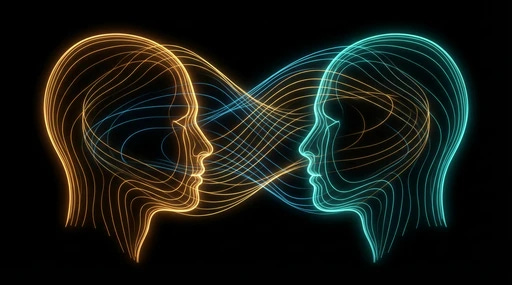
Around your childhood best friend, a version of you emerges that your work colleagues have never met. With your kids, you become someone your college roommate wouldn’t recognize. At a dinner party with strangers, yet another self shows up , tentative, performing, reading the room.
Are these masks? Are all but one of them fake? Or is something more interesting going on? There’s a philosophy from Southern Africa called Ubuntu , often translated as “I am because we are.”
It’s the idea that a person exists through their relationships, not despite them. You aren’t a fixed thing that bumps into other fixed things. You’re something that comes into focus because of the people around you. Like how a musical note only becomes harmony or dissonance in relationship to the notes beside it.
A 19th-century Hasidic rabbi named the Kotzker Rebbe said: “If I am I because you are you, and you are you because I am I , then I am not I and you are not you.” He’s not contradicting Ubuntu. He’s completing it.
Yes, we emerge through relationships , but only if each person in the relationship is showing up as genuinely themselves, not as a reaction to the other. The harmony only works if each instrument is actually playing its own note.
So What Are You Afraid to Know?
Maybe the thing you’re afraid to know isn’t some dark secret lurking in your psychology. Maybe it’s simpler than that, and harder: You might be in the wrong room.
Not broken. Not disordered. Not failing at being a person. Just trying to tune yourself to a reference note that was never yours. Your body has been telling you. That tension in your chest, that unshakeable restlessness, that feeling of performing a version of yourself that never quite lands , those aren’t symptoms. They’re signals.
The question isn’t how to silence them. The question is: What happens if you finally listen?
What’s the signal you’ve been overriding? I’d genuinely love to hear , because I think the most important truths are the ones we discover together.
References
Buber, M. (1937). *I and Thou*. (R. G. Smith, Trans.). Edinburgh: T. & T. Clark.
Damasio, A. (1994). *Descartes' Error: Emotion, Reason, and the Human Brain*. New York: G.P. Putnam's Sons.
Gilbert, D. (2006). *Stumbling on Happiness*. New York: Alfred A. Knopf.
Libet, B., Gleason, C. A., Wright, E. W., & Pearl, D. K. (1983). Time of conscious intention to act in relation to onset of cerebral activity (readiness-potential): The unconscious initiation of a freely voluntary act. *Brain*, 106(3), 623-642.