

It’s 10:30 on a Tuesday night. Both exhausted. And it starts , the way it always starts , with something small.
“You never support me.”
She says it quietly, which makes it worse. He puts down his phone.
“What are you talking about? I literally spent all weekend helping you prepare for that presentation. I rewrote the financial section. I stayed up until 2am.”
“That’s not what I mean.”
“Then what do you mean? I supported you.”
“No. You helped me. That’s not the same thing.”
And now they’re both angry. He’s angry because the evidence is right there , the lost weekend, the 2am finish, the tangible sacrifice. She’s angry because she can’t even articulate what’s missing without sounding ungrateful. So she says it again, slightly louder, as if volume might carry the meaning that words couldn’t.
“You never support me.”
They will argue about this for an hour. Maybe two. They will both feel unheard. They will both be right.
Because they are having two completely different conversations in what sounds like the same language.
The Private Dictionary
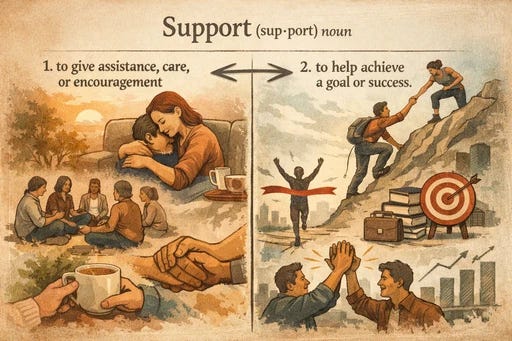
Here’s what’s actually happening in that argument. When she says “support,” her body is retrieving a felt experience , probably from childhood, probably pre-verbal , of someone sitting with her when she was overwhelmed. Not fixing anything. Not solving anything. Just being present in a way that made the overwhelm survivable. Her nervous system encoded that as support. The word is a compressed file containing an entire emotional history.

When he hears “support,” his body retrieves something completely different. Maybe a father who showed love by getting things done. Maybe a household where support meant contribution, action, sacrifice of time. His nervous system encoded that as support. Different compressed file. Same label on the folder.
Neither of them is wrong. That’s the thing that makes this so maddening. They’re both accessing legitimate, deeply encoded emotional definitions. But they’re treating the word as if it’s a window they’re both looking through at the same view, when actually it’s two different windows in two different rooms that happen to have the same curtains.
And here’s the mechanism underneath that , the thing that makes this not just unfortunate but structurally inevitable. Every word in an intimate relationship functions as a carrier of encoded emotional instructions. When she says “support,” she isn’t just labelling a concept. She’s transmitting an entire instruction set , here’s what should happen now, here’s what my nervous system expects to receive, here’s the emotional sequence that the word is compressed from. But that instruction set assumes the receiver has identical emotional architecture. Identical developmental firmware. Identical experiential setup. It assumes the destination looks like the origin.
It never does.
Think about cooking a family recipe. Your grandmother’s “pinch of salt” and my grandmother’s “pinch of salt” could differ by a factor of three. The words are identical. The instruction feels universal. But one produces what your body recognises as home and the other tastes slightly wrong in a way you can’t explain. The recipe was encoded in one kitchen and decoded in another, and the assumption that both kitchens were the same , same stove, same altitude, same grandmother , is where the dish goes wrong. Not the recipe. Not the cook. The assumption.
That’s the wrong assumption we make with every emotionally significant word. Not that we chose the wrong word. Not that we failed to communicate clearly. But that we assumed the emotional setup at the receiving end was identical to the one we sent from.
The transmission didn’t fail. The assumption embedded in the act of transmission was wrong from the start.
The Glossary of Invisible Disagreement
“I need space.”
To one partner, this means: I need a few hours alone to process something internally before I can show up properly for you. To the other, this decodes as: I am pulling away from you. This is the beginning of abandonment. One person requests space to preserve the relationship. The other experiences the same request as a threat to it. The word “space” carries an instruction , give me room , but the emotional architecture at the receiving end renders that instruction as prepare for loss. Same carrier. Different hardware. Different output.
“I love you.”
One means: I feel a profound coherence when I’m near you , my internal signals and my external reality align, and my body tells me this is right. The other means: I am choosing you, daily, despite difficulty , love is my sustained commitment, not a feeling. One is reporting a state. The other is declaring an action. When the first person stops feeling it temporarily and says nothing, the second person experiences betrayal , because in their dictionary, love is a choice you make out loud. The instruction encoded in “I love you” assumed the receiver would recognise a feeling. The receiver was listening for a decision.
“You’re not being honest with me.”
One means: You’re withholding information I need to feel secure. The other means: You’re performing a version of yourself that doesn’t match who you are when I’m not looking. One is asking for transparency of facts. The other is asking for authenticity of being. You could satisfy one completely and still fail the other entirely.
“You’re not putting in effort.”
One means: You’re not initiating plans, dates, gestures , the visible architecture of trying. The other means: You’re not paying attention to what I feel without me having to say it. One is asking to be pursued. The other is asking to be known. And pursuing someone you don’t know is precisely what feels hollow.
Every one of these words is a trapdoor. You both step on it with total confidence, and one of you falls through.
Why This Isn’t a Relationship Problem , It’s a Consciousness Problem
Here’s where it goes deeper than couples therapy.

All communication , every sentence you’ve ever spoken to another human being , operates on the same fragile assumption: that encoding meaning into words on one end and decoding it on the other will produce the same felt experience. It almost never does.
This isn’t a bug. It’s a structural feature of how consciousness works.
Your experience of reality is your own private rendering. Your nervous system takes in raw data from the environment , sensory signals, social signals, threat signals , and renders a conscious experience that serves your survival, shaped by your history, calibrated to your accumulated emotional encodings. What you call “the world” is already an interpretation before a single word is spoken.
Language, then, is the attempt to compress one private rendering into symbols, transmit those symbols through air, and hope they decompress into something resembling the original experience inside someone else’s entirely different rendering system. Every word is a carrier of encoded emotional instructions , but those instructions presuppose an emotional architecture at the destination that mirrors the origin. The word arrives intact. The carrier works perfectly. But the receiving system opens it with different software, different developmental history, different survival encodings , and produces something that looks close enough that neither person realises they’re experiencing different content.
That’s the deep structure. It’s not that communication is hard. It’s that communication is, at the level of felt meaning, structurally asymmetric. The encoding and the decoding happen in two fundamentally private rendering systems that never had identical architecture, not even for a moment.
And in relationships , where the words carry the most emotional weight, where they’re wired deepest into our survival systems, where the stakes of being misunderstood feel existential , this structural asymmetry becomes most dangerous. Because in relationships, we don’t just need to be heard. We need to be heard as we meant it.
The Fractal Pattern
This same pattern , the same signal decoded differently depending on the observer’s architecture , repeats at every scale. It’s not unique to couples arguing at 10:30 on a Tuesday.
A manager says “I need you to take more ownership.” One employee hears: make decisions without asking permission. Another hears: work longer hours. A third hears: stop bothering me with problems. Same instruction carrier. Three different emotional setups at the receiving end. Three different behavioural outputs. Three different disappointments at the next performance review.
A nation declares “freedom.” Half the population’s nervous systems decode it as: freedom from government interference in my choices. The other half decodes it as: freedom from economic conditions that prevent me from having real choices. Same word. Two entirely different instruction sets, each assuming the other half has the same emotional firmware. They’ll argue about this for decades. Both are right. Neither can hear the other, because they’ve never surfaced the private rendering behind the public word.
The pattern is always the same: shared language creates the illusion of shared meaning. The carrier signal arrives. The emotional instructions it contains assume identical architecture at the destination. The receiving system decodes using its own architecture. And the gap , which is structural, not personal , gets misread as a moral failure.
That’s where the damage lives. Not in the misunderstanding itself, but in the story we tell about why we were misunderstood. We skip straight from they didn’t understand me to they don’t care about me. The structural asymmetry of language gets reinterpreted as evidence of relational betrayal.
So What Do You Actually Do With This?
I’m not going to tell you to “communicate better.” That’s the advice equivalent of telling someone lost in a foreign city to “just go the right way.” The problem isn’t effort or willingness. The problem is that you don’t know you’re speaking a different language, because it sounds identical to yours.

So the first move is just this: assume the emotional architecture doesn’t match.
Not as a technique. Not as a therapeutic exercise. As an honest recognition that the word coming out of their mouth was encoded from an emotional experience you haven’t lived, using developmental firmware you don’t share, inside a rendering system you’ve never directly accessed. You are hearing your own definition, projected onto their lips. Every single time.
The second move is the one that actually changes things: ask for the experience, not the word.
Not “what do you mean by support?” , that just produces another word, another compressed carrier that will land on your architecture and decode into your version again. Instead: “Can you describe a time you felt supported? What was happening? What did it feel like in your body?”
Now you’re not decoding their language through your dictionary. You’re stepping inside their rendering. You’re asking to see what plays on their screen. You’re saying: show me your architecture so I can understand what the instruction was supposed to produce.
This is, quietly, one of the most intimate things two people can do , more intimate than the words “I love you,” which after all might mean something completely different to each of them. It’s the willingness to say: I don’t actually know your inner world, even after all these years. Show me.
And here’s the part that surprises people: this doesn’t create distance. It creates closeness. Because the loneliness of being misunderstood in a relationship isn’t that your partner got the words wrong. It’s the feeling that they never even tried to learn your language. That they assumed their dictionary was the only one. That they heard themselves when you were speaking.
The moment someone says, genuinely, tell me what you mean , not the word, the feeling underneath it , something in your nervous system settles. You feel seen. Not because they decoded you perfectly, but because they acknowledged that decoding is necessary. That you are not transparent. That your inner world requires active exploration, not assumption.
That’s intimacy. Not shared language. Shared willingness to learn that you don’t share a language at all.
The Screen You’re Both Watching
So tonight, if you’re lying next to someone and a word lands wrong between you , if “fine” doesn’t sound fine, if “nothing” clearly means something, if “I love you” somehow doesn’t land , resist the impulse to argue about the word. The word isn’t the point. It never was.
The word was just the carrier. The instructions it carried assumed you were built the same way. You weren’t.
Ask instead: what’s playing on your screen right now?
And then , this is the hard part , actually watch.