

This is Part 1 of a three-part series exploring why the architecture of consciousness virtually guarantees that your ego will capture your spiritual experience , and what genuine transformation actually requires.
The Architecture of Awakening
Let me start with one of spirituality’s most treasured words. Presence. You know the feeling. That moment when the mental chatter quiets, the to-do list dissolves, and you’re simply here , in the room, in your body, in the moment.
It feels like arriving somewhere. Like waking up. Every contemplative tradition points toward it. An entire industry , retreats, apps, books, teacher lineages , is built around helping you get there.
The felt shift between being caught in mental narration and arriving in sensory immediacy , that’s genuine experience.
And that feeling is real. I want to be clear about that before we go any further. The shift between being caught in mental narration and arriving in sensory immediacy is real. Your body knows the difference. Honour that.
But here’s what I want to explore: what if presence isn’t something you achieve , but something you can’t escape? In your own conscious reality, you’re always present. Always, without exception.
The Direction of Your Gaze
You can’t step outside your own experience. Consciousness is a display system , it is always rendering something. The only variable is what channel it’s showing. Right now, as you read these words, you are present.

If your mind drifts halfway through this sentence to what you’re having for dinner tonight , you are still present. In the dinner. You haven’t lost presence. You’ve relocated it.
Your conscious mind shifted which reality it’s displaying, but at no point did you stop being here , in your own experience. Consider someone on a psychedelic journey. To an outside observer, they might appear completely gone , unreachable, disconnected, absent.
But ask them what’s happening internally and they’ll tell you they’ve never been more here. They are overwhelmingly present in their own conscious reality , so immersed that they’ve entirely decoupled from the shared reality the observer inhabits.
Presence isn’t binary , present or absent. It’s directional. You’re always present somewhere.
Or something more mundane: you’re reading a book that completely absorbs you. Someone calls your name. Nothing. They tap your shoulder and you startle , ‘Sorry, I was somewhere else.’ But you weren’t somewhere else. You were right here , in the world between your consciousness and the page.
Meditation as Redirection
When meditation works , when you shift from the mental narration loop to sensory immediacy , what you’re experiencing isn’t the creation of presence. It’s the redirection of it. You were always present.
You were just present in the narrative , in the story about yourself, your day, your worries, your plans. And that narrative is its own reality, one you’re completely immersed in. Meditation redirects the display from the narrative channel to the sensory channel.
Neuroscientist Antonio Damasio‘s research supports this architecturally , the body generates feeling and orientation before the conscious mind narrates it. The sensory channel is primary. The narrative channel is a secondary rendering.
So when meditation quiets the narration and you arrive in sensory immediacy, you’re not achieving something extraordinary. You’re returning to the more fundamental channel , the body’s direct encounter with reality that was running underneath the narration all along.
The Observer’s Paradox
The moment you notice you’re present , ‘I’m here, I’m really in the moment right now’ , something shifts. Not because you’ve failed at meditation, but because noticing is itself a form of narrating. The display has shifted from rendering sensory reality to rendering a story about sensory reality.
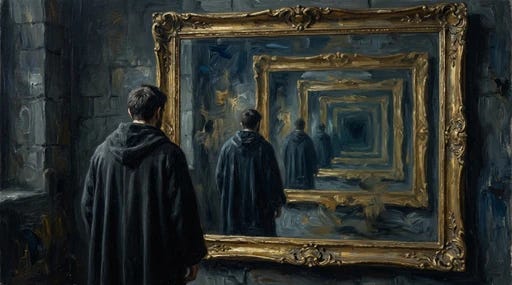
You’re now fully present , in an account of your own presence. The observation becomes the departure. This isn’t a problem with your practice. This isn’t a lack of discipline. This is a structural feature of how consciousness operates.
Alan Watts saw this decades ago. He described it with characteristic elegance: trying to be present through effort is like trying to make your eyes see themselves, like trying to bite your own teeth. The act of grasping defeats itself because the grasper and the thing grasped are the same system.
The act of grasping defeats itself because the grasper and the thing grasped are the same system.
But Watts couldn’t explain why this is structurally inevitable. He could point at it poetically, but he didn’t have the architecture. So his prescription was essentially: just see it. Just recognise the trap and it dissolves.
Which sounds liberating until you notice that ‘just seeing it’ is itself another move by the display screen. Consciousness observing its own limitations is still consciousness doing what it does , rendering. The screen cannot reprogram the broadcast by displaying a picture of its own circuitry.
The Reality of the Render
What’s actually going on? Why does this pattern repeat with such reliability , not just in meditation, but across the entire landscape of spiritual seeking? The answer lies in something fundamental about consciousness itself.

Consciousness is downstream of the processes it displays. This isn’t philosophy , it’s measured neuroscience. Benjamin Libet‘s pioneering experiments demonstrated that neural activity preceding a conscious decision fires roughly 300-500 milliseconds before a person reports awareness of deciding.
Your brain has already moved before ‘you’ know it. More recent work by researchers like John-Dylan Haynes has extended this finding, showing that some decisions can be detected in brain activity up to several seconds before conscious awareness.
What this means is profound: every decision, every shift in awareness, every so-called ‘awakening’ , these are processes completed by the subconscious before the conscious mind registers them.
The Mechanical Inevitability
Consciousness is a rendering of events that have already occurred beneath awareness. When you ‘decide’ to be present, that decision was already made by systems operating below the threshold of awareness. Consciousness then displays it as: ‘I chose to be present.’
Consciousness is a rendering of events that have already occurred beneath awareness.
But the ‘I’ didn’t choose. The ‘I’ is what the choice looks like once it reaches the screen. This is why Watts‘ prescription , ‘just see the trap’ , can’t fully work. Seeing is what the display does. You cannot use the screen to reprogram the broadcast. The architecture doesn’t allow it.
And this structural feature of consciousness , the fact that it renders rather than initiates , is precisely what makes the spirituality trap not a personal failure but a mechanical inevitability. One that every spiritual seeker encounters, whether they recognise it or not.
In Part 2, we’ll explore why the genuine spiritual signal is real , and why consciousness virtually guarantees that your ego will capture it. Not because you failed, but because of three structural features working exactly as designed.
References:
Damasio, A. (1999). *The Feeling of What Happens: Body and Emotion in the Making of Consciousness*. New York: Harcourt Brace.
Dennett, D. C. (1991). *Consciousness Explained*. Boston: Little, Brown and Company.
Libet, B., Gleason, C. A., Wright, E. W., & Pearl, D. K. (1983). Time of conscious intention to act in relation to onset of cerebral activity (readiness-potential): The unconscious initiation of a freely voluntary act. *Brain*, 106(3), 623-642.
Soon, C. S., Brass, M., Heinze, H. J., & Haynes, J. D. (2008). Unconscious determinants of free decisions in the human brain. *Nature Neuroscience*, 11(5), 543-545.
Watts, A. (1957). *The Way of Zen*. New York: Pantheon Books.