

In Part 2 we arrived at the spirituality trap , the structural inevitability that consciousness will render any genuine mystical signal into narrative, and that narrative will cement into the ego’s vault and receive the same automatic protection as every other core identity.
So if the trap is architectural , if it’s not a failure of discipline but a feature of how consciousness operates , is there any way through?
There is. But it requires releasing one of spirituality’s most cherished assumptions: that transformation is an inside job.
The Architecture of the Vault
The vault , that neurological place where your core identity is cemented and automatically protected , has a design feature that most spiritual frameworks never address: it cannot open from the inside.
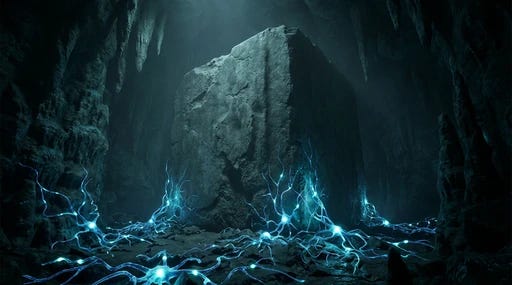
The vault cannot open from the inside.
Think about what we established in Parts 1 and 2. Consciousness is downstream , it renders processes already completed by the subconscious. The vault operates pre-consciously , it defends before you’re aware of the threat.
So any conscious strategy to ‘transcend’ the ego , any meditation, any intention, any insight , arrives at the vault after the vault has already responded. You cannot outrun a system that fires before you know it’s firing.
This isn’t philosophy. Stephen Porges’ polyvagal theory has mapped how the nervous system’s deepest protective responses operate beneath conscious control , the body reads threat and mobilises defense long before the mind narrates what’s happening.
Bessel van der Kolk’s work on trauma demonstrates the same principle from the clinical side: the body stores protective patterns in ways that purely cognitive approaches cannot access. You cannot think your way into the vault.
The vault doesn’t speak the language of conscious thought. It speaks the language of the nervous system , safety, threat, protection. So when a spiritual practitioner sits in meditation and ‘observes the ego dissolving’ , what’s actually happening?
The display is rendering a picture of ego dissolution. The conscious mind is showing itself a story about transcendence. But the vault , the actual neurological structure where core identity is cemented , is operating beneath that display, untouched by the graphics on the screen.
The screen cannot reprogram the broadcast. The vault cannot open from the inside. This isn’t a limitation to overcome. It’s a design specification to understand.
The Psychedelic Mirror
Perhaps the most dramatic illustration of this architecture comes from psychedelic experience , because psychedelics actually do soften the vault, and what happens next proves the entire framework.

Robin Carhart-Harris’s research at Imperial College has mapped it directly: psychedelics significantly reduce activity in the default mode network , the neural architecture we’ve been calling the vault. The cementation loosens. The rigid boundaries of ‘this is who I am’ temporarily lose their hold.
And what’s revealed when the vault softens isn’t nothing , it’s everything. People report the dissolution of individual identity. The boundaries between self and world become porous.
There’s an overwhelming sense of being part of something vastly larger , connected to everything, merged with reality itself. And here’s what I think is critical: they’re not hallucinating. They’re perceiving more accurately.
Think about it through the framework. The self, as we normally experience it, is a constriction , a collapse of vast relational possibility into a particular identity structure, cemented and protected by the vault.
When the vault softens, that constriction loosens. What floods in is the relational field that was always already there , the encounter with reality that the vault normally narrows to a manageable bandwidth.
The drug didn’t create the experience of connectedness. It removed the obstruction that was preventing you from experiencing what was already the case. This is why psychedelic experiences feel more real than ordinary reality, not less.
But here’s where the architecture reveals its trap in the purest possible form. The vault softens temporarily. Reality floods in. The boundaries dissolve. And then , the vault re-cements. The default mode network restabilises.
Individual identity reconsolidates. And what does consciousness do with that flood of unrenderable signal? Exactly what it always does. It narrates. ‘I experienced ego death.’ ‘I felt oneness with the universe.’ ‘I am part of something bigger.’
Now you have something remarkable: a person whose ego is organised around the experience of having had no ego.
And that narrative , vivid, profound, emotionally charged , settles into the vault the way all emotionally charged narratives do. It cements. Same vault. Same protection. The most spectacular spiritual content possible. And the trap closes again.
Relational Transcendence
So what actually opens the vault , not temporarily, but in a way that produces lasting restructuring? A different observer. This sounds abstract until you’ve experienced it.
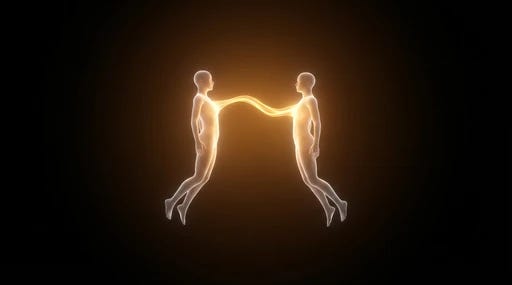
Think of a moment when someone saw you , really saw you , in a way you couldn’t see yourself. Not flattered you. Not affirmed your self-narrative. Actually reflected back something about you that your own display had never rendered.
That’s the mechanism. Not metaphorically , structurally. The vault responds to relational encounter in ways it doesn’t respond to internal reflection.
Porges’ research shows that the nervous system has a dedicated social engagement system , it reads safety and connection through face, voice, and relational presence.
The vault’s protective mechanisms can soften , not through willpower or insight, but through the felt experience of being met by a nervous system that signals safety. The body reads another body. Beneath consciousness. Beneath narrative.
Transformation is constitutively relational; it cannot happen in isolation because the self that needs transforming only exists in relation.
This is why every serious contemplative tradition embeds the seeker in a relational structure. Zen has the teacher-student bond. Sufism has the sheikh. Hasidism has the rebbe. Kabbalah has the chevruta. Christianity has the confessor.
These aren’t institutional accessories. They’re there because the vault cannot open from the inside. When these traditions all converge on the same structural requirement , you need relational encounter , that convergence is itself significant.
They’re not copying each other. They’re encountering the same architectural reality: transformation is constitutively relational. And this is precisely why psychedelic therapy with trained guides produces fundamentally different outcomes than solo trips.
Healing the River
So genuine transformation looks less like achieving something and more like removing obstructions. Healing , and I use this word deliberately rather than ‘awakening’ , is less like building something and more like clearing a blocked river.
The water knows where to go. Your job isn’t to direct it. Your job is to find the relational contexts that soften what’s in the way. Not through force. Through safety. Through sustained encounter with observers who meet you in ways your own display never could.
This is what Van der Kolk’s research points toward when he writes that the body keeps the score , the wound lives in the nervous system, in the vault’s cemented protective patterns, not in the stories we tell about it.
The stories are the display’s rendering. The actual pattern is deeper than narrative can reach. Which is precisely why approaches that work through the body and through relational encounter tend to produce the deepest restructuring.
The body already knows what it needs. The signal is already coming through. The subconscious processes reality with an intelligence that dwarfs conscious comprehension.
The challenge is that the vault cemented around patterns that were once genuinely protective, and now those patterns prevent the natural elasticity that would let new relational configurations take hold. Your job is to find the relational fields where they can safely soften.
The Signature of Groundlessness
Let me close with something that sits at the heart of all this. The deepest spiritual contact , the genuine encounter with what consciousness can’t render , has a signature. And that signature is not certainty. It’s not ‘I know.’

It’s groundlessness.
The real mystics don’t say ‘I am awake.’ They say ‘I don’t know what I am.’ The apophatic theologians describe the divine by what it is not , because any positive description is a rendering, and the rendering is always less than the reality.
Zen’s ‘don’t know mind’ isn’t a technique , it’s a description of what genuine contact with the unrenderable actually feels like. The Kabbalists insist that Ein Sof , the infinite , cannot be named, and that every name is already a reduction.
They’re not being mystical for the sake of it. They’re being mechanistically accurate. They understood that naming the signal is how the vault captures it. So they built traditions around preserving the signal in its unrendered state.
If awakening is something you achieved, it’s your ego’s finest performance.
The deepest shifts , the ones that actually restructure the vault , are precisely the ones you can’t narrate from inside your own experience. They show up not in what you say about yourself, but in how others experience you. Not in your story, but in your relational field.
If it’s something you can’t quite name , something that left you more open, more uncertain, more groundless than before , something that shows up in how you meet other people rather than in how you describe yourself , that might be the real thing.
And you’ll never be entirely sure. Not because you failed. Because that’s what genuine contact with reality feels like when the display can’t fully capture it. The traditions knew this. Perhaps it’s time modern spirituality remembered.
References
Carhart-Harris, R. L., Leech, R., Hellyer, P. J., Shanahan, M., Feilding, A., Tagliazucchi, E., Chialvo, D. R., & Nutt, D. (2014). The entropic brain: A theory of conscious states informed by neuroimaging research with psychedelic drugs. *Frontiers in Human Neuroscience*, 8, 20.
Porges, S. W. (2011). *The polyvagal theory: Neurophysiological foundations of emotions, attachment, communication, and self-regulation*. New York: W. W. Norton & Company.
Pseudo-Dionysius the Areopagite. (c. 500 CE). *The mystical theology*. (Various translations available)
Seung Sahn. (1997). *The compass of Zen*. Boston: Shambhala Publications.
*The Cloud of Unknowing*. (14th century). Anonymous. (Various modern editions available)
Van der Kolk, B. (2014). *The body keeps the score: Brain, mind, and body in the healing of trauma*. New York: Viking.