

I want to tell you something that happened to me that I still can’t fully explain.
I was sitting in a meeting, maybe three years into living in a new country , and someone made a joke. Everyone laughed. I laughed too. But I noticed something strange: I had laughed in English. Not translated the joke and found it funny , I had experienced the humour directly in the language it arrived in. No intermediary. No subtitles running in my head.
And I realised in that moment that I was not the same person I was in my mother tongue.
Not metaphorically. Not poetically. I mean the thoughts I could think, the emotions I could access, the version of reality available to me , had structurally shifted. There were things I could articulate in English that I had never even thought in my first language. Not because I lacked vocabulary , because the conceptual architecture didn’t exist there. And there were depths of feeling, textures of memory, entire emotional registers available in my mother tongue that English couldn’t touch. Not wouldn’t , couldn’t.
I was two different people. Not by choice. By language.
And that experience broke something open for me about the nature of reality itself.
Your Language Isn’t Describing Reality , It’s Rendering It
Here’s what most people think language does: you perceive reality, and then you describe it with words. Reality first, language second. The world exists in full colour, and language is just the label maker.
That’s wrong. And we can show it’s wrong.
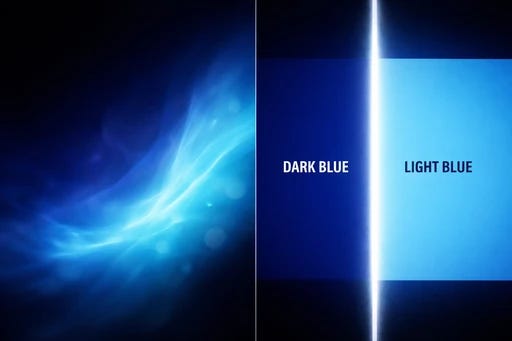
Russian has two separate words for blue , goluboy for light blue and siniy for dark blue. These aren’t adjective-noun combinations like English’s “light blue.” They’re distinct colour categories, as different to a Russian speaker as green and yellow are to you. And here’s the part that should stop you cold: when researchers tested Russian speakers against English speakers on their ability to distinguish shades of blue, Russian speakers were measurably faster at detecting differences that crossed their linguistic boundary. Not because they had better eyes. Because their language had carved a perceptual border into reality that English leaves unmarked.
The language you speak changes what you see. Not what you think about what you see. What you actually, perceptually, neurologically see.
The Kuuk Thaayorre people in Australia don’t use left and right , they use cardinal directions. “Move your north foot.” “The cup is southeast of the plate.” As a result, they maintain a constant, precise awareness of orientation that feels almost superhuman to English speakers. They aren’t choosing to track compass direction. Their language makes it impossible not to. The linguistic structure isn’t describing a skill , it’s installing one.
The Hopi language , and I know there’s debate about the strong form of Whorf’s hypothesis here , structures time differently from Indo-European languages. Where English forces you to grammatically mark past, present, and future as distinct containers, Hopi verb forms encode whether something is a known fact, an expectation, or a general truth. The temporal architecture is different. And if your language architecturally distinguishes between what happened, what is expected to happen, and what is generally the case rather than past, present, and future , you aren’t just talking about time differently. You’re inhabiting a different temporal reality.
This isn’t linguistics. This is existential.
The Migrant Knows Something the Monolingual Can’t
I want to stay with the migration experience for a moment, because there’s something here that monolinguals literally cannot access , not through lack of intelligence but through lack of the felt experience of having your reality split open by a second language.
When you learn your first language as a child, you don’t experience it as a language. You experience it as reality. The words aren’t symbols mapped onto things , the words are the things. Tree isn’t a label for that tall thing with leaves. Tree is what it is. The distinction between word and world hasn’t formed yet. Your mother tongue doesn’t feel like a lens. It feels like your eyes.
Then you migrate. And you start thinking in another language. And the first thing that happens is vertigo.
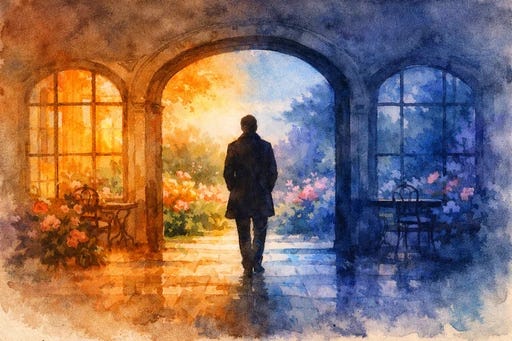
Because you discover that the thing you thought was a window , a transparent view onto reality , was actually a painting on the wall.
Convincing. Beautiful. But not a window. A rendering. Your first language was rendering reality in a specific way, and you never knew, because you had nothing to compare it to.
It’s like spending your entire life in a room with amber-tinted windows. Everything looks natural to you. Warm. Real. Then someone opens a door to a room with blue-tinted windows and you see the same garden but it looks completely different , the shadows fall differently, certain flowers become visible that were invisible before, others vanish. And the vertigo isn’t that one room is right and the other wrong. It’s that you realise you were never seeing the garden. You were seeing the window.
That’s what happens to a migrant’s mind. And it’s simultaneously the most disorienting and the most liberating experience I know. Disorienting because the ground you thought was solid turns out to be a perspective. Liberating because if it’s a perspective , if this one is , then reality is larger than any single language told you it was.
The Words You Don’t Have Are the Thoughts You Can’t Think
Here’s where it gets existential.

The Portuguese word saudade describes a deep emotional state of longing for something absent , not just missing someone, but a melancholic awareness of absence itself, tinged with the knowledge that what’s absent may never return. English has no word for this. Not “nostalgia,” which is softer and more pleasant. Not “longing,” which is too active. Saudade is a state of being. The Portuguese-speaking world has elevated it to a cultural identity , it permeates their music, literature, national character.
Now here’s the question that should keep you up tonight: do English speakers feel saudade?
The obvious answer is yes , of course they do, they just don’t have a word for it. But the research on linguistic relativity suggests something more unsettling. Without the word, the emotional state doesn’t crystallise into a recognisable, nameable, thinkable experience. It remains a vague ache that consciousness can’t quite render into focus. The feeling might be there , the body might be producing the neurochemical signature , but without the linguistic architecture to decode it, it stays subconscious. Pre-verbal. A signal your system is sending that your conscious mind can’t receive because it lacks the antenna.
Your language isn’t just limiting what you can say. It’s limiting what you can consciously experience.
The Japanese concept of mono no aware , the bittersweet awareness of impermanence, the gentle sadness that arises from knowing that beauty exists precisely because it passes. English speakers can understand this intellectually when it’s explained. But Japanese speakers inhabit it. It’s woven into their aesthetic sensibility, their relationship with seasons, their experience of cherry blossoms. It’s not a thought they have , it’s a perceptual mode they live in.
The German Schadenfreude , pleasure derived from another’s misfortune , existed as a felt experience for English speakers long before they borrowed the word. But notice what happened after they borrowed it: it became thinkable. Articulable. Socially recognisable. A murky, slightly shameful sensation that people experienced privately became a shared category of human experience. The word didn’t create the feeling. But it crystallised it , moved it from subconscious signal to conscious rendering.
This is the mechanism. Language doesn’t generate emotions or perceptions from nothing. The body is always producing signals , always reading the environment, always generating felt states. But language determines the bandwidth at which consciousness can render those signals. A rich linguistic architecture for a particular domain of experience means higher resolution rendering. Fewer words means lower resolution. Blurrier. Harder to think about. Eventually, below the threshold of conscious access.
What you can’t name, you can’t think. What you can’t think, you can’t consciously navigate. And what you can’t consciously navigate is still shaping your experience , but from below, from the body, from the pre-verbal survival system, where you feel it but can’t quite know it.
Every Language Is a Different Collapse of Reality
Here’s where this connects to something much deeper than linguistics.
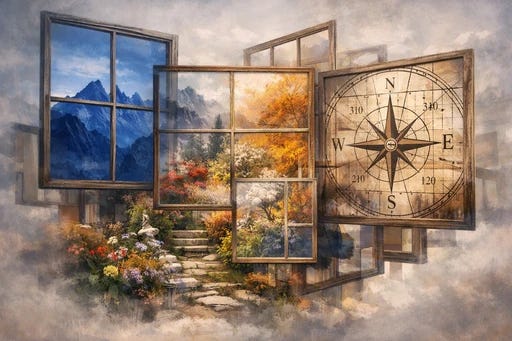
I’ve spent a lot of time thinking about how reality works , how consciousness renders experience, how the observer shapes the observed. And what I keep arriving at is this: objective reality, whatever it is in its fullness, exists as something like an inexhaustible superposition , a totality that contains more than any single perspective can capture. Every act of observation, every point of view, every framework collapses that superposition into a specific, partial rendering. Genuine. Real. But partial.
Every language is a different collapse.
English collapses the colour spectrum into categories that make certain distinctions visible and others invisible. Russian collapses it differently , suddenly blues split into two realities. Neither is wrong. Neither is complete. Each reveals something the other hides.
The Hopi temporal system collapses time into categories that make certain aspects of reality navigable that English obscures. English’s past-present-future architecture makes other aspects visible. Neither is the territory. Both are maps. And every map, by definition, includes some features and omits others.
This is not relativism. I’m not saying all maps are equally useful or that reality is whatever your language says it is. There’s a garden out there. The flowers are real. But every language is a different window onto that garden , different tint, different angle, different frame , and no single window shows you everything.
The Kuuk Thaayorre aren’t imagining their constant compass orientation. They’re perceiving something real about spatial reality that English speakers’ window doesn’t reveal. The Portuguese aren’t inventing saudade. They’re rendering an emotional reality at a resolution that English can’t achieve. These are genuine facets of an inexhaustible reality, made visible by specific linguistic architectures and invisible by others.
And that means something uncomfortable: every monolingual person is living in a partial rendering of reality and experiencing it as the whole thing. Not through ignorance. Through the structural limits of their linguistic window. The frame feels like the world because you can’t see the frame from inside it.
The Thoughts You Cannot Think
This is what haunts me.
If Russian reveals blues that English hides. If Hopi reveals temporal structures that Indo-European languages flatten. If Portuguese renders emotional states that English leaves blurry. If Kuuk Thaayorre makes spatial awareness visible that left-right languages obscure.
Then what is every language hiding?
What emotional states exist that no human language has yet crystallised into a word? What perceptual categories are real but linguistically unmarked in every living language? What thoughts are structurally unthinkable , not because they’re too complex, but because no linguistic architecture has yet been built that would render them into consciousness?
The body is always producing more signal than consciousness can render. That’s the fundamental asymmetry. The subconscious system takes in everything , every sensory input, every subtle environmental shift, every micro-expression on a face across a crowded room. Consciousness gets the compressed summary. And language determines the compression algorithm.
Think about what happens when you hear a piece of music that moves you to tears but you can’t explain why. Your body is receiving and processing a complex signal , harmonic relationships, rhythmic patterns, timbral textures, associations with memory and longing and beauty. The signal is real. The experience is genuine. But you don’t have the linguistic architecture to render it into thought. So it stays in the body. Felt but not known. And someone trained in music theory can name what’s happening , the suspension resolving to the tonic, the minor seventh implying movement toward home , and suddenly a portion of that signal crystallises into conscious awareness. The word didn’t create the experience. But it moved it from felt to known.
Now multiply that across every domain of human experience. Emotional states. Perceptual categories. Temporal structures. Social dynamics. Spiritual experiences.
There are realities your body is registering right now that your language cannot render into thought.
The Liberation in Not Knowing
I started this with a moment in a meeting , laughing in English and realising I had become someone else. Let me end with what that realisation actually gave me.
It gave me permanent epistemological humility. Not the performed kind, where you say “I could be wrong” while being certain you’re right. The felt kind. The kind that lives in your body because you’ve experienced reality restructuring itself when you moved between languages. You don’t go back from that.
Every framework I encounter now , scientific, philosophical, spiritual, psychological , I experience as a language. A specific collapse. A window with a specific tint. It reveals something genuine about reality and simultaneously hides something else. Not because it’s wrong. Because it’s a rendering. And renderings, by their nature, are partial.
And this is not paralysing. It’s the opposite. Because once you know you’re looking through a window, you start asking: what does the window next to this one show? What would reality look like from there? You stop arguing about whose window is the real one and start moving between them. You become a migrant not just between countries but between ways of seeing.
The monolingual mind is a mansion with one window. Beautiful view. Feels complete. But the migrant has been through the door into the next room and seen the garden from a different angle, and now knows , not believes, knows , that every window is partial. That reality is always more than what any single rendering can show.
The most important thoughts you will ever have might be the ones your current language cannot think. The most important feelings might be the ones no word in your vocabulary can crystallise. They’re there , in your body, in your subconscious, in the raw uncompressed signal your nervous system is always receiving.
Language gave you the extraordinary gift of conscious thought. It also set the walls of your cognitive room.
The question isn’t whether those walls exist. They do. For everyone. In every language.
The question is whether you know you’re inside them.
References
Boroditsky, L. (2011). How language shapes thought. Scientific American, 304(2), 62-65.
Damasio, A. (1999). The Feeling of What Happens: Body and Emotion in the Making of Consciousness. New York: Harcourt Brace.
Whorf, B. L. (1956). Language, Thought, and Reality: Selected Writings of Benjamin Lee Whorf (J. B. Carroll, Ed.). Cambridge, MA: MIT Press.